River Protection Group


What's New?

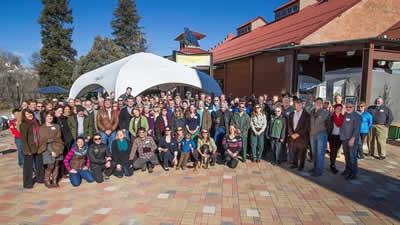
Presentation given 1/24/12 to the Colorado Water Conservation Board by Bruce Whitehead (SWCD), Wendy McDermott (SJCA) and Marsha Porter-Norton (Facilitator)

About the River Protection Workgroup

About the River Protection Workgroup

What is it?
See a Power Point on the RPW project here:

Basic RPW Project Presentation

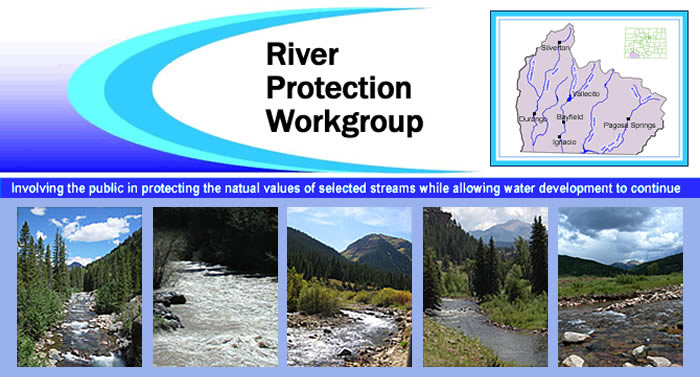
The River Protection Workgroup or “RPW” is a community-driven project in Southwest Colorado that covers five river and stream segments. The purpose of this multi-year project is:

  • to bring diverse stakeholders together in a collaborative process to determine values needing protection – ecological, economic and social;
  • to recommend the types of tools necessary, either existing or newly-developed, to protect the values; &
  • to make recommendations in the context of striking a balance between the protection of natural values and water development.

Find a glossary of agencies involved in the RPW, water/stream protections, and water issues here >>

Find a glossary of commonly-used terms here >>

About the RPW’s Workgroups
A Steering Committee formed in 2006 to plan the project and guide the process (see members and organizations to the right). The project has organized Workgroups, which are open to everyone, on five streams/river segments including: Hermosa Creek; the Animas River above Baker’s Bridge; Vallecito Creek/Pine; San Juan – East and West Forks; and the Piedra River.
Each Workgroup is facilitated by a professional and uses a set of process principles including:
  • Anyone with an interest is a stakeholder and has a seat at the table
  • Respectful dialogue 
  • Solutions are crafted that address a diversity of interests 
  • Use of accurate facts and information 
  • Lots of interaction – consensus – collaboration – possible negotiations 
  • Fair, open, transparent process 

Initially, the Workgroup members get to know each other and learn about the diverse interests and concerns involved. Over the course of three to four months, participants educate themselves on the river/stream via reading and discussing detailed Information Sheets and by hearing from speakers on key topics. Field trips are also hosted when possible. Most handouts given to each Workgroup member can be found on the Web site (refer to the buttons on the left).

Then, the Workgroups develop comprehensive values statements focused on documenting the full range of ecological, economic and social values, or simply put, what members care about related to that particular river, stream segment or watershed. Finally, the level of desired protection(s) needed is discussed in great detail. Arriving at what the Workgroups believe represent desired protections is done by consensus. However, if that is not possible, the Workgroup’s final reports reflect all the ideas and range of opinions expressed.

The measures for river/stream protection that Workgroups consider, learn about and discuss cover a wide range of “tools” including, but not limited to, the federal Wild and Scenic Rivers Act ("WSR").

A tool kit developed by the Steering Committee can be found here >>


Reports
The outcome of each Workgroup is a report (please refer to the buttons on the left to access the reports). The RPW reports are widely disseminated to federal, state and local governments and elected officials; non profits; Workgroup members and their various constituents; conservation and water development groups; the media; and the affected communities at large. The RPW Workgroup’s findings do not bind any entity, including governments, to any specific action. The recommendations and ideas represented in the reports reflect the issues, conversations, processes and outcomes of each Workgroup, and are distributed publicly reflecting a grassroots, community-driven process.

Funding is from in-kind donations from many of the entities involved and grants from San Juan Citizens Alliance, Southwestern Water Conservation District, Trout Unlimited – Five Rivers Chapter, Southern Ute Indian Tribe, Colorado Water Conservation Board, The Wilderness Society, and the National Forest Foundation. Other grants are pending.

In 2013, Phase II of the process, a Regional Discussion, will begin which will evaluate each of the Workgroup’s findings and determine if a regional approach(es) to protecting values while allowing water development to continue can be crafted and gain broad support. Be looking on this Web site for more details about the Regional Discussion which is set to start in early 2013 and will be led by the Steering Committee.

About the RPW’s History
The San Juan Public Lands Center (USFS and BLM) is required, in its public lands planning process, to evaluate rivers in their area for “eligibility” and “suitability” for the federal Wild and Scenic River designation. They released their draft Plan in 2007. In 2006, a Government to Government Roundtable met and discussed these issues. It became apparent that a collaborative, community-driven process was needed to engage the broader public in identifying values – economic, ecological, and social – for select river/stream segments and to determine if agreement can be found on the appropriate level(s) of protection. The San Juan Citizens Alliance approached the Southwestern Water Conservation District and they agreed to launch the project by forming a Steering Committee as the first step.


Contacts
For more information:

Marsha Porter-Norton, Facilitator and Project Coordinator for the Hermosa Creek, San Juan, and Animas Workgroups (970-247-8306 or porternorton@bresnan.net)

Bruce Whitehead, Southwestern Water Conservation District (970-247-1302 or water@frontier.net)  

Wendy McDermott, San Juan Citizens Alliance (970-259-3583 or wendy@sanjuancitizens.org)

Tami Graham, Facilitator for the Vallecito Creek/Pine and Piedra Workgroups (970-759-9716 or tamigraham11@gmail.com)